
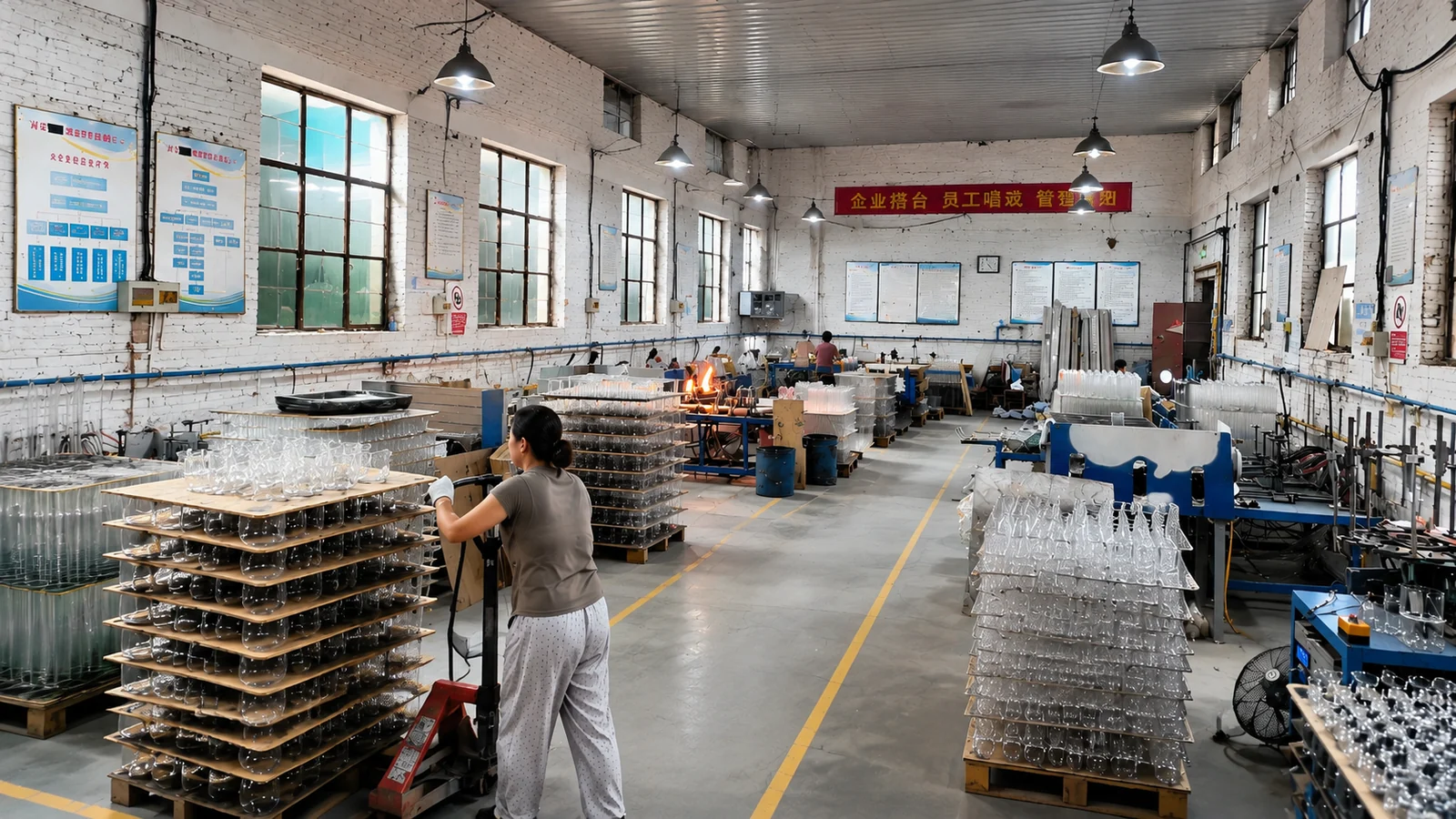
Buyers sometimes ask us to “start production” while the capacity, artwork or pack is still changing. From the supply side, production starts much earlier than molten or heated glass reaches a forming step. It starts when we choose a feasible route and convert the buyer’s request into one controlled product definition.
Guangyi Glass works as a sourcing and project-coordination team with manufacturing partners selected for the product and process. We do not present every workshop as a factory we own. Our responsibility is to connect the commercial brief, approved sample, production documents, inspection requirements and shipment release so the buyer is not managing unrelated decisions through chat messages.
Step 1: decide whether the project needs an existing or new route
The first production decision is not decoration. It is whether a current glass body can meet the use. We compare the target capacity, dimensions, mouth, base, handle or double-wall construction, material direction and intended process with existing product records.
A current model can shorten the decision path because there is a body to measure and sample. It does not mean every specification is already guaranteed. Availability, tolerances, performance, decoration compatibility and packing still need confirmation. A buyer can also request a combination of features that no existing route supports safely or economically.
New development may require a drawing, prototype approach, mould review and more than one approval round. The buyer should understand which feature justifies that work. If the commercial difference is only a logo or handle color, an existing body may be the more controllable route. If a unique shape or interface is central to the product, development may be justified.
Read how we structure a custom glassware development project.
Step 2: turn the RFQ into a production brief
A workable brief identifies the model or drawing, intended use, material direction, capacity and measurement method, important dimensions, decoration, components, quantity per finished SKU, packing, destination and required approvals. It also distinguishes facts from open questions.
We use an open-point list. For example:
- body model is current, but the requested lid fit is unverified;
- capacity is nominal in the catalogue and must be checked on the sample;
- logo artwork is received, but size and viewing face are not approved;
- buyer wants parcel sales, but only export-carton packing has been discussed;
- target date is known, but sample and artwork approval dates are not.
This list keeps production from assuming that silence means approval. It also helps the buyer see which decisions affect price or schedule.
Step 3: calculate MOQ by production setup and finished SKU
MOQ is linked to the chosen manufacturing route. Existing bodies, new tooling, hand-worked forms, machine-made runs, colored components, decoration and printed cartons can each have different setup conditions. One order total does not erase those conditions.
Current product records on this site commonly use 500–1,000 pieces as a planning range for current-model trial orders and around 2,000 pieces as a standard OEM planning baseline. These figures are not universal manufacturing laws. The dated MOQ is confirmed after we know the quantity for every capacity, color, logo and pack.
The production partner also needs to consider material and schedule efficiency. A project divided into many small variants can create more setup and identification risk than a larger single-SKU order. When the buyer’s first quantity cannot support the intended customization, we review whether a simpler current-model version is possible. We do not promise a low minimum before the partner and component route confirm it.
Our MOQ guide explains the three routes we normally review.
Step 4: use samples to close specific open points
“Sample approved” can mean very different things. We separate the physical body, decoration and packaging approvals.
A current plain sample helps confirm shape, nominal capacity direction, dimensions, hand feel and component interface. A development sample or prototype addresses a new body or structural change. A decorated sample addresses logo size, color, position and appearance on curved glass. A packing sample addresses the product, accessories, insert, box and labels as a complete unit.
Current-model records commonly state a 5–10-day sample lead reference once the request is clear. That range does not cover every new mould, special finish, custom component or printed package. We check the chosen partner and inputs before issuing a dated sample plan.
We ask the buyer to approve against written points. A photograph is useful evidence, but a message saying “looks good” may not identify whether capacity, color or pack was included. The approved reference, comments and version date become part of the bulk file.
Step 5: freeze the specification before bulk authorization
After sample review, we prepare the production definition. Depending on the project, it can include the product drawing or model record, approved sample identity, artwork file, color reference, component list, quantity table, packing instruction, carton marks and inspection criteria.
“Freeze” does not mean changes are forbidden. It means a requested change is evaluated. A larger logo may require another decoration sample. A new capacity changes the SKU table. A new lid can affect fit and the insert. A box count change affects carton dimensions and freight planning. The buyer sees those consequences before the change reaches bulk production.
This stage also makes quotations comparable. If another quote excludes decoration sampling, custom inserts or inspection, its unit figure is not for the same finished deliverable.
Step 6: coordinate the selected forming route
The exact glass cup forming process depends on the product. A simple machine-made tumbler, a hand-worked borosilicate cup, a handled mug and a double-wall cup do not follow one identical line. We confirm the process with the selected manufacturing partner instead of using one generic factory story for every SKU.
At this stage, the partner controls process settings and production execution. Our project role is to keep the approved model, quantity and critical characteristics visible. Form, rim, base, wall profile, handle or double-wall relationship may require attention depending on the item. Process variation is managed against the agreed specification and sample; it is not judged from an unrelated catalogue photo.
Annealing or other thermal-control steps are part of the route where applicable to the chosen process. We do not make a product-level thermal performance claim merely because a process includes heating and controlled cooling. The intended-use claim and evidence remain separate approval questions.
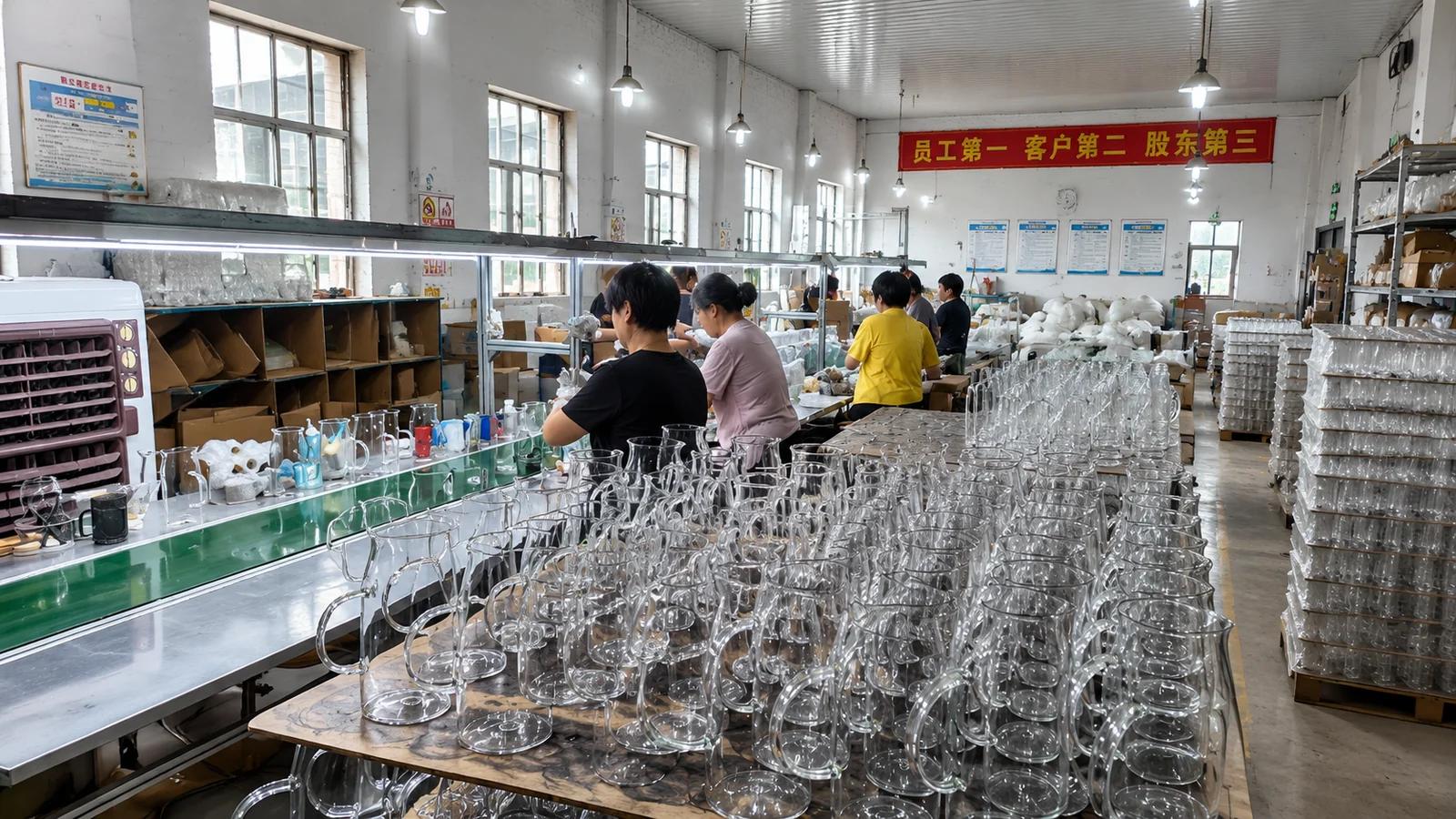
Finishing requirements depend on the selected cup. The image is evidence of partner capability, not a claim that every order uses this exact line.
Step 7: finishing and decoration create new control points
After the main body is formed, the route may include trimming, fire polishing, handle work, surface treatment, cleaning or other finishing operations depending on the design. Each added step can introduce its own visible or dimensional variation. The QC brief must match the operations actually used.
Decoration is then controlled by the approved artwork and reference. We check product orientation, logo size and position, color appearance and SKU identity. A handle can determine the viewing face. A double-wall profile can affect how a logo appears. Durability requirements need a defined use or test method; we do not publish a universal decoration-life claim.
When several artworks share the same body, line clearance and identification matter. The old artwork, packing materials and labels must not carry into the next version. The purchase specification and carton code should let the team trace the correct combination.
Step 8: inspect during the process, not only at the end
Final inspection cannot repair a process that has produced the wrong model or artwork. We use checkpoints appropriate to the risk: confirm inputs and components, monitor relevant forming or finishing characteristics, check decoration startup, and verify the packed product against the approved SKU.
The exact inspection frequency and acceptance method are agreed for the order. Critical, major and minor categories are defined by effect, not by vague words such as “premium quality.” A sharp or unusable condition is treated differently from a controlled cosmetic variation. Repeated signals are contained and investigated rather than hidden inside an average result.
See what happens during a coordinated glassware quality inspection.
Step 9: develop packing around the finished cup
Packing is not safely finalized from the initial drawing alone. The finished dimensions, rim, handle, components and set count determine contact points and movement. We review inner protection, dividers or inserts, retail presentation where required, export-carton count, carton marks and the destination handling route.
A retail color box is not automatically a parcel-shipping solution. A bulk restaurant carton is not automatically suitable for a gift set. The buyer tells us the sales channel and any required test method so the packaging partner can develop the correct job.
Carton dimensions and weights are needed for freight planning. If these are estimated before the final sample, they should remain marked as estimates until the packing is approved.
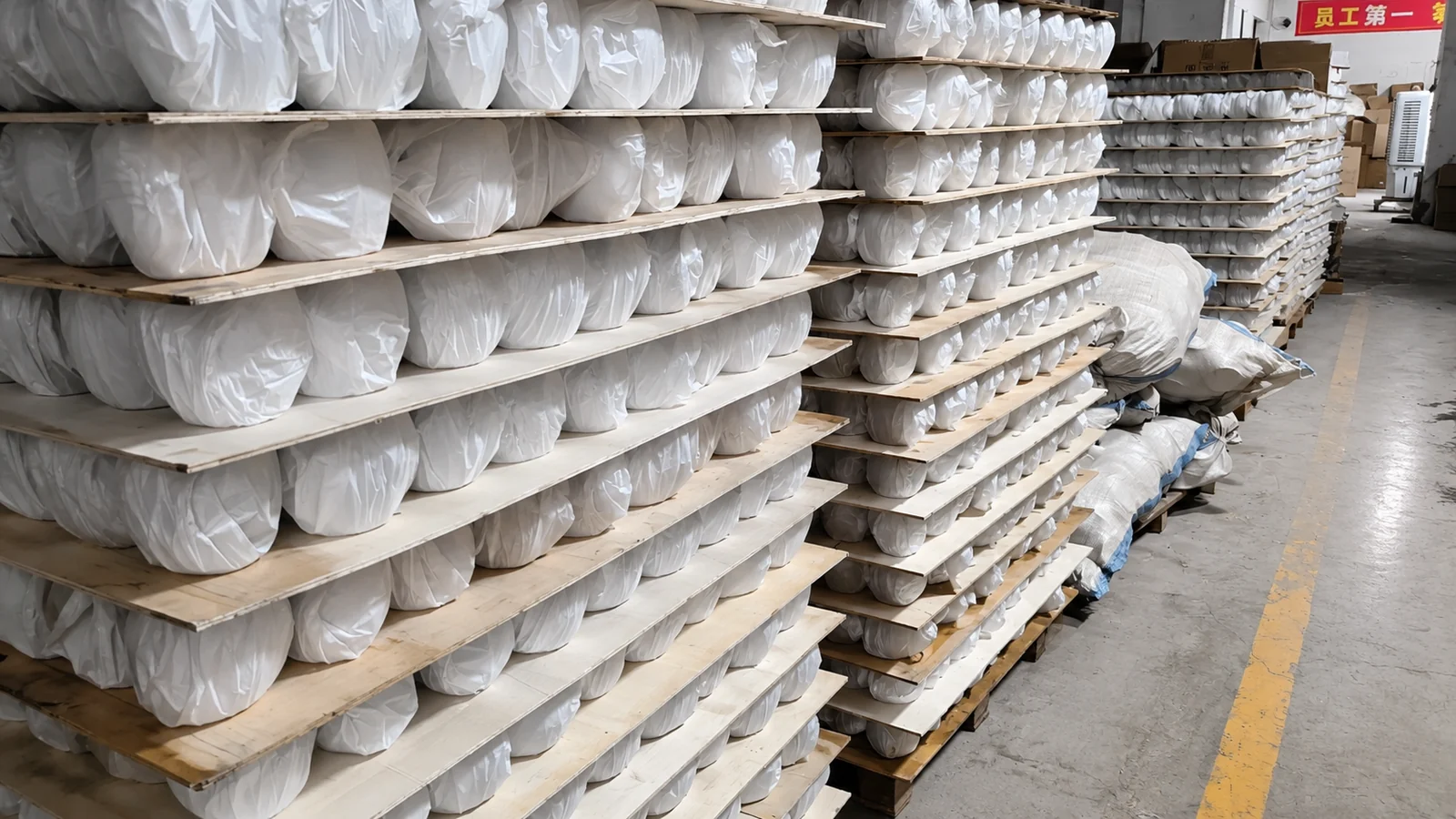
Final protection, count and marks follow the approved cup and distribution route.
Review the packaging routes available for glassware projects.
Step 10: release the shipment against the order record
Before release, the team checks the inspection result, quantity, SKU and carton identity, packing information and shipment documents against the purchase order. If the buyer uses a third-party inspector or nominated forwarder, the booking and communication path should be known before goods are ready.
We keep factory production timing separate from freight timing. A dated project plan can include specification review, sample, approval, bulk scheduling, forming, finishing, decoration, inspection, packing and handover. The duration depends on the route and production-partner availability. We do not claim one fixed bulk lead time for every cup.
Glass cup production FAQ
Does Guangyi Glass manufacture every cup in its own factory?
We coordinate sourcing and production through selected manufacturing partners. The partner and process depend on the cup construction, quantity and finish. We identify the route for the project rather than implying that every workshop is company-owned.
Can an existing glass cup be customized?
Often, subject to model availability and process review. Logo, color, component and packing options vary by product. We confirm compatibility, MOQ and sample needs before quotation.
What is the production MOQ?
Current-model trial planning commonly starts at 500–1,000 pieces in our product records, while standard OEM planning often begins around 2,000 pieces. Final MOQ is set by the exact model, capacity, color, decoration, components and pack.
How long does a sample take?
Defined current-model samples commonly use a 5–10-day reference. New tooling, special finishing, decoration, components or packaging can add stages. We provide a dated schedule after route confirmation.
When can bulk production begin?
After the specification, quantity allocation, required sample, artwork, components, packing direction and acceptance criteria are approved, and the selected production partner confirms readiness.
How do buyers prevent specification drift?
Use one version-controlled order file that links the approved sample, drawing or model, artwork, components, pack and QC criteria. Review every later change for its effect before authorizing it.
Send the inputs that control the route
For a production review, send the closest product link or drawing, intended use, capacity and dimensions, quantity per finished SKU, decoration, components, packing, destination and target delivery window. Tell us what must be proved on the sample. We will separate confirmed facts from open points and identify the manufacturing-partner route before preparing the bulk quote.
Browse current glass cup options, use our RFQ preparation guide, or contact Guangyi Glass.